

CoQ10 for Heart Health: What the Research Shows for Indians (2026)
Key Takeaways
- ✓Heart muscle burns through CoQ10 faster than almost any other tissue in the body
- ✓Natural CoQ10 production starts declining noticeably from your 30s and 40s
- ✓Statins can lower blood CoQ10 levels by up to roughly half
- ✓Absorption depends more on formulation than on ubiquinone versus ubiquinol
- ✓Diet, movement and sleep still matter more than any single capsule
Quick Answer
CoQ10 for heart health works because this antioxidant powers energy production inside heart-muscle cells, which need more fuel than almost any other tissue in the body. Research suggests CoQ10 may support heart function in people with heart failure and in adults on statin therapy, whose CoQ10 levels often drop. Most studies use 100–300 mg daily, taken with a meal.
Introduction
Heart disease shows up in Indians almost a decade earlier than it does in the West, and it isn’t a small gap. A Global Burden of Disease analysis puts India’s age-standardised cardiovascular death rate at 272 per 100,000 people, well above the global average of 235, and large population studies keep confirming the early-onset pattern.
That’s a big reason doctors across Indian metros are prescribing statins to patients well before they turn 50.
It’s also why CoQ10 for heart health has become such a common question in nutrition consults because statins, while they genuinely save lives, come with a quiet side effect most patients are never told about.
Coenzyme Q10 is a compound your heart cells depend on for energy. Statins can lower it, and so can simply getting older. For a country where a large share of the population eats vegetarian, where organ meats and oily fish (the richest dietary sources of CoQ10) rarely make it to the plate, natural intake is often on the lower side to begin with.
This isn’t a supplement pitch dressed up as an article. It’s a walk through what the actual research says the solid parts, the shaky parts, and the parts still being studied. By the end, you’ll know exactly what the evidence supports, how much to take, and which form actually gets absorbed.
What Is CoQ10?
Coenzyme Q10 is a fat-soluble compound that lives inside almost every cell in your body, packed most densely into the ones that work hardest heart, kidneys, liver, and muscle.
Inside each cell sit mitochondria, the structures that convert food and oxygen into usable energy. CoQ10 sits right in the middle of that process, shuttling electrons along the chain that produces ATP, the molecule your cells actually run on.
Here’s where it gets interesting: your heart never really rests. It beats roughly 100,000 times a day, which makes it one of the most energy-hungry organs you have, and one of the tissues with the highest natural concentration of CoQ10.
CoQ10 also moonlights as an antioxidant. In its reduced form, called ubiquinol, it neutralises free radicals before they damage cell membranes and mitochondrial DNA and this matters for the heart specifically, since oxidative stress is one mechanism researchers link to the progression of heart failure.
The catch is that your body’s own CoQ10 production peaks in your 20s and quietly declines after that, a pattern seen consistently across ageing research. Certain medications, especially statins, speed up this decline further, which we’ll get into shortly.
Diet is supposed to fill some of the gap, but this is where many Indians fall short without realising it. The richest food sources organ meats like liver and heart, and oily fish like mackerel and sardines barely feature in a typical vegetarian thali, and plant sources such as peanuts, sesame oil, and spinach contain CoQ10 in far smaller amounts. With roughly half the country eating vegetarian, dietary CoQ10 intake alone often falls short of what research studies actually use.
How Does CoQ10 Support Heart Health?
Research points to three main mechanisms, and each one plays a slightly different role in why CoQ10 keeps showing up in cardiology research.
Cellular Energy Production
Your heart muscle depends on a constant, uninterrupted supply of ATP just to keep beating. CoQ10 sits inside the mitochondrial electron transport chain, the exact machinery that produces that ATP, which is why heart tissue carries some of the highest natural CoQ10 concentrations in the body.
Researchers publishing in JACC: Heart Failure have noted that lower myocardial CoQ10 levels track with more severe heart failure. That’s an association, not proof that low CoQ10 causes worse heart failure, but it explains why the compound draws so much research attention in cardiology circles.
Oxidative Stress & Antioxidant Defence
Heart tissue takes a constant beating from free radicals, byproducts of the very energy production that keeps it going. CoQ10, in its active ubiquinol form, helps neutralise these free radicals before they damage cell membranes and mitochondrial DNA.
A systematic review and meta-analysis of CoQ10 supplementation found it significantly raised markers of total antioxidant capacity while lowering malondialdehyde, a marker of oxidative cell damage. This antioxidant angle matters more in Indian cities than people realise, given how air pollution and high-stress schedules both add to the body’s oxidative load though the review’s own authors were careful to note that more research is needed before drawing firm clinical conclusions from biomarker changes alone.
Statin Support
Statins are one of the most effective tools we have against heart disease, and increasingly common in Indian prescriptions given how early cholesterol problems tend to show up here. But statins block an enzyme called HMG-CoA reductase, and that same enzyme sits upstream of both cholesterol and CoQ10 production so lowering one quietly lowers the other.
Studies have measured statin users’ blood CoQ10 dropping by anywhere from 16 to 54 percent. The Q-SYMBIO trial, the largest and longest CoQ10 heart failure study to date, followed 420 patients with moderate-to-severe heart failure for two years and found that adding 300 mg of CoQ10 daily to standard treatment nearly halved the risk of major cardiovascular events compared with placebo (30 events versus 57, with a hazard ratio of 0.5).
That’s a meaningful result, but it’s worth being precise about who it applies to: these were heart failure patients already on standard medical therapy, not healthy adults simply managing cholesterol. If you’re a statin user without heart failure, the more realistic expectation is that CoQ10 may help restore what the medication depletes, not that it replaces or outperforms your prescription.
Convinced it’s worth trying? Here’s the one we recommend → LipoMax Liposomal CoQ10 300mg
What Does the Research Actually Show?
Here’s where a lot of supplement marketing gets ahead of the science, so let’s slow down and look at what the evidence really supports.
This matters more in India than the headlines suggest. An ICMR study found that nearly 8 in 10 Indian adults have at least one lipid abnormality, which is a big part of why statin prescriptions and CoQ10 conversations are becoming so common here.
The most recent Cochrane review on CoQ10 and heart failure, published in 2021, pooled data from 11 randomised trials and just over 1,500 participants. Its conclusion: CoQ10 probably reduces all-cause mortality and heart-failure-related hospitalisations. That word “probably” is doing real work Cochrane graded the evidence as low to moderate quality, not high, because many of the underlying trials were small and relatively short.
That’s actually progress. An earlier version of the same Cochrane review, back in 2014, found no clear mortality benefit at all. The difference between the two conclusions largely comes down to the Q-SYMBIO trial, which added enough high-quality, long-term data to shift the picture.
On blood pressure, a large 2025 meta-analysis pooling 45 trials found CoQ10 lowered systolic blood pressure by roughly 3 to 4 mmHg on average, with no measurable effect on diastolic pressure. That’s real, but modest closer to what you’d get from cutting back on salt for a few weeks than from starting a new blood pressure medication.
Where the Evidence Is Strong and Where It Isn’t
The honest limitation across this body of research is population: most of the strongest data comes from people with existing heart failure or confirmed CoQ10 depletion, not from healthy adults hoping to prevent heart disease from scratch.
Backed by Research
- Adjunct support in diagnosed heart failure (Q-SYMBIO, Cochrane 2021)
- Restoring CoQ10 depleted by statin use
- A modest reduction in systolic blood pressure
- Improved antioxidant capacity markers in blood
Not Yet Proven
- A substitute for statins or blood pressure medication
- A guaranteed energy boost in healthy adults
- Reversing existing heart disease or blockages
- A universal, one-size-fits-all dose for everyone
CoQ10 is not a proven substitute for statins, blood pressure medication, or lifestyle changes the research simply doesn’t support that claim, and no honest nutritionist should tell you otherwise.
Who May Consider CoQ10?
CoQ10 tends to make the most sense for a specific set of people, rather than being a blanket recommendation for every adult.
Adults over 40 are a reasonable starting point, simply because natural CoQ10 production has usually declined by then. Statin users are another group worth highlighting, given what we now know about statins and the mevalonate pathway this is genuinely one of the better-supported reasons to consider supplementing.
People focused on active ageing, whether that’s regular badminton games, morning walks, or gym sessions past 50, sometimes look to CoQ10 for stamina support. A meta-analysis of 13 trials did find a statistically significant reduction in fatigue scores with CoQ10 versus placebo, though the effect was modest and the causes of fatigue are wide-ranging.
If fatigue is your main complaint, get it checked medically first thyroid function, anaemia, vitamin B12, and sleep quality are far more common causes of tiredness than low CoQ10, especially in Indian adults, where B12 and iron deficiencies are widespread.
Check With Your Doctor First If You Are:
- Pregnant or breastfeeding
- Currently on blood-thinning medication such as warfarin
- Scheduled for surgery in the near future
- Undergoing chemotherapy or radiation treatment
These aren’t reasons to avoid CoQ10 forever they’re reasons to get it right with medical guidance first.
Not sure if this suits you? Talk to our nutrition experts it’s a free consultation.
CoQ10 Dosage for Heart Health: Timing & Best Form
Let’s keep this simple, because dosage confusion is where most people go wrong with CoQ10.
Research studies on heart health commonly use between 100 mg and 300 mg per day. Lower doses, around 100 mg, tend to show up in general wellness and antioxidant research, while the higher end 200 to 300 mg is what trials like Q-SYMBIO used for heart failure patients specifically.
Timing matters more than people expect. CoQ10 is fat-soluble, meaning it needs some dietary fat around it to absorb properly, and taking it on an empty stomach, or with just black coffee or chai before breakfast, is one of the most common reasons people feel like “it isn’t working.” Often, there’s nothing wrong with the supplement itself.
| Form | Typical Dose | Best Timing | Notes |
|---|---|---|---|
| Ubiquinone (standard) | 100–200 mg/day | With a fat-containing meal | Most researched, budget-friendly form; naturally low absorption on its own |
| Ubiquinol (active form) | 100–200 mg/day | With a fat-containing meal | The body’s active form; may suit adults 50+ with reduced conversion capacity |
| Liposomal CoQ10 | 100–300 mg/day | With any meal; fat less critical | Encapsulated for improved absorption; common in higher-dose protocols |
Here’s the confusion most Indians run into: assuming a higher price automatically means better absorption, or that ubiquinol is always superior to ubiquinone. Neither is guaranteed the research shows formulation and delivery technology often matter more than which specific form you pick. Splitting a higher dose into two smaller ones across the day can also help some people tolerate it better than one large dose.
Getting Started, Step by Step
- Talk to your doctor about whether CoQ10 fits your health profile, especially if you’re on statins or blood thinners.
- Pick a form ubiquinone, ubiquinol, or liposomal based on your budget and absorption needs.
- Take it consistently with a meal containing some fat, at roughly the same time each day.
- Reassess after 4 weeks, and check in with your doctor if you’re on other heart medications.
When in doubt, start with the lower end of the range and assess after 4 weeks.
Pure Nutrition’s Liposomal CoQ10 300 mg capsules deliver exactly that dose per serving see the full label and ingredient breakdown.
Pure Nutrition’s Expert Take
We’ve worked with a lot of customers over 40 who come to us after their doctor puts them on a statin, asking what else they should be doing. CoQ10 is almost always part of that conversation.
One pattern our team has noticed: people who’d tried a basic CoQ10 capsule before and felt nothing different were often surprised by how much timing and formulation changed their experience not the dose itself. That lines up with what the research on CoQ10 absorption actually shows: this is a molecule that’s notoriously hard for the body to absorb in its raw, powdered form, so how it’s delivered matters almost as much as how much you take.
That’s the exact problem liposomal delivery is built to solve. Wrapping CoQ10 in a lipid-based carrier gives it a better shot at surviving digestion intact, rather than passing through largely unused.
It’s also why we formulated LipoMax at a research-aligned 300 mg per capsule, in a vegetarian capsule that fits into an Indian daily routine one capsule, with a meal, no complicated schedule to remember. We won’t tell you a supplement replaces your cardiologist’s advice, because it doesn’t. But if you and your doctor have already decided CoQ10 is worth trying, formulation is the detail most people overlook.
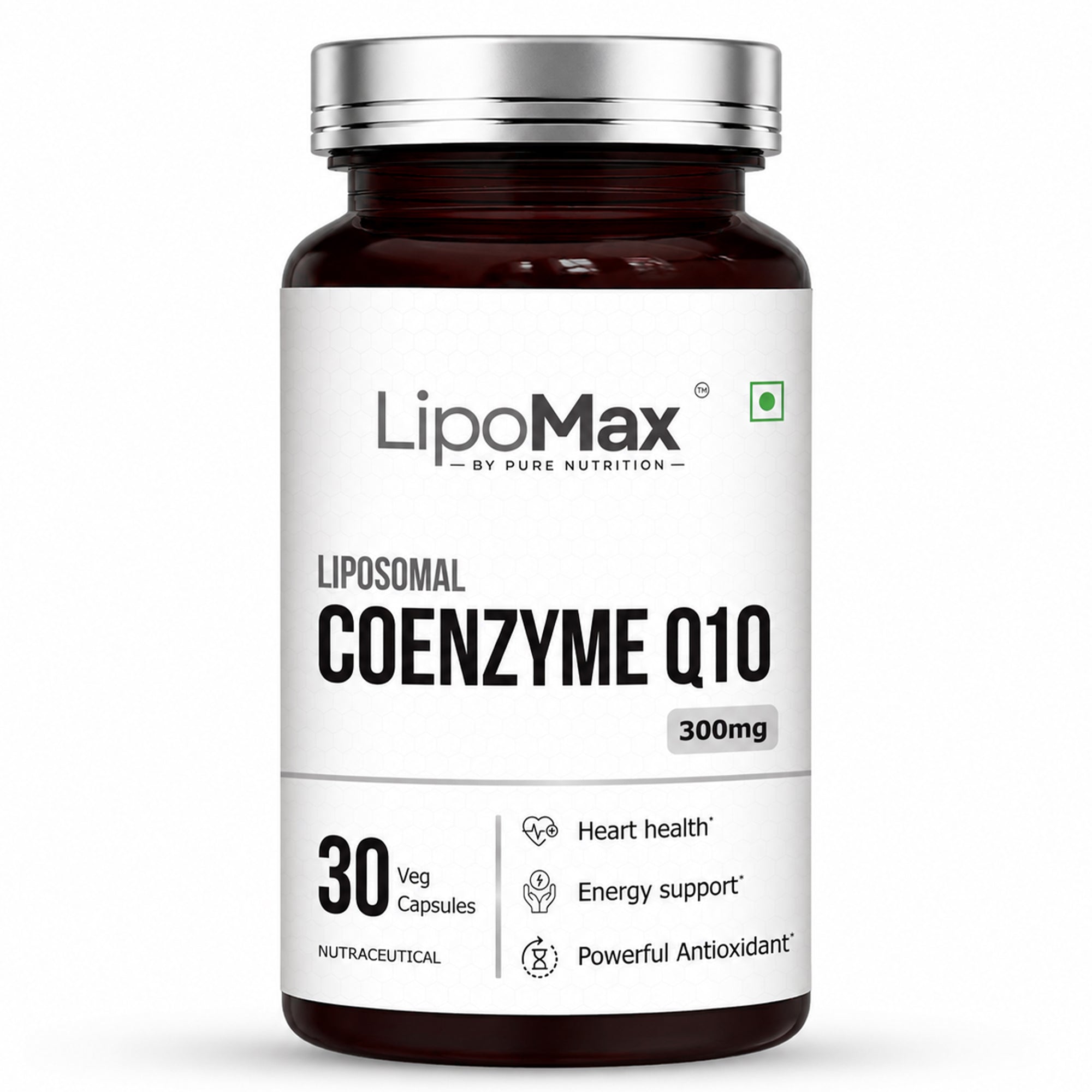
LipoMax Liposomal Coenzyme Q10 300mg
30 vegetarian capsules • Liposomal format • GMP-compliant facility
See Full Label & DetailsUbiquinone vs Ubiquinol vs Liposomal CoQ10
If you’re standing in front of a shelf, or a screen, trying to pick between three different CoQ10 bottles, here’s a side-by-side to make the decision easier.
None of these forms is universally “best” the right choice depends on your budget, whether you’ve had absorption concerns before, and what your doctor has recommended. Regular ubiquinone is the most economical starting point, ubiquinol suits adults whose bodies convert CoQ10 less efficiently with age, and liposomal formats are built specifically around the absorption problem that affects all forms of CoQ10 to some degree.
| Form | Absorption | Approx. Monthly Cost | Vegetarian | Best For | Frequency |
|---|---|---|---|---|---|
| Regular CoQ10 (Ubiquinone) | Low, and highly variable between individuals | ₹400–800 | Usually (check label) | Budget-conscious beginners | 1–2×/day |
| Ubiquinol | Higher plasma levels in some studies | ₹1,200–2,200 | Usually (check label) | Adults 50+, reduced natural conversion | 1×/day |
| Liposomal CoQ10 | Designed for improved uptake | ₹1,000–1,200 | Often veg capsules (check label) | Simplified, higher-dose daily use | 1×/day |
These are approximate Indian market ranges rather than fixed prices, since individual brands vary. Pure Nutrition’s own liposomal 300 mg formula falls within that liposomal range above.
Common Mistakes Indians Make With CoQ10
Even a well-chosen CoQ10 supplement can underperform if a few small habits get in the way. Most people get this part wrong in one of five ways.
-
Taking it on an empty stomachCoQ10 needs dietary fat to absorb. Pairing it with just your morning chai and nothing else is one of the most common reasons people feel no effect pair it with breakfast instead.
-
Stopping after a weekThis isn’t a painkiller. Even the strongest clinical trials measured results over months, not days, so judge it after at least four weeks of consistent use.
-
Chasing the lowest price onlyA cheap 60-capsule bottle can look like better value than it actually is if poor absorption means very little of it reaches your bloodstream.
-
Buying based on marketing, not the label“Ubiquinol” and “liposomal” both sound advanced, but the milligram dose and formulation quality matter more than the buzzword on the box.
-
Not mentioning it to your doctorCoQ10 is generally safe, but it can interact with blood thinners, blood pressure medication, and diabetes medication, so your doctor needs to know you’re taking it.
Frequently Asked Questions
Does CoQ10 really help heart health?+
Research suggests CoQ10 can support heart function, particularly in people with heart failure or those on statin medication. The strongest evidence comes from the Q-SYMBIO trial, where CoQ10 supplementation alongside standard heart failure treatment roughly halved the risk of major cardiovascular events over two years. For healthy adults without diagnosed heart disease, evidence is more limited, so think of CoQ10 as support for specific situations rather than a universal heart-health fix.
Can CoQ10 be taken with statins?+
Yes, CoQ10 is commonly taken alongside statins, and many doctors recommend it because statins can lower the body’s natural CoQ10 levels by roughly 16 to 54 percent. Some research shows this may ease statin-related muscle aches in certain patients, though results across studies are mixed. Always mention any supplement, including CoQ10, to the doctor managing your statin prescription.
How much CoQ10 should I take daily?+
Most clinical studies on heart health use doses between 100 mg and 300 mg per day, usually taken with a meal containing some fat. The right amount depends on why you’re taking it, since statin users and heart failure patients are often studied at the higher end of that range. Start with the lower end and speak to a healthcare provider before going higher.
Is CoQ10 safe to take every day?+
CoQ10 has a strong long-term safety record and is generally well tolerated even at the higher doses used in research. The most common side effects are mild nausea, stomach upset, or occasional insomnia and affect only a small percentage of users. It does interact with blood thinners like warfarin and may affect blood sugar and blood pressure medications, so daily use should be discussed with a doctor if you’re on any of these.
Which form of CoQ10 absorbs better: liposomal or regular?+
Standard CoQ10 powder absorbs poorly on its own, often in the low single digits as a percentage, because the molecule is large, fat-soluble, and doesn’t dissolve well in water. Liposomal and other advanced delivery formats are built specifically to work around this problem, and several studies show improved absorption over plain powder-filled capsules. Head-to-head comparisons between liposomal CoQ10 and ubiquinol are still evolving, so formulation quality matters more than chasing one specific form.
How long does CoQ10 take to show results?+
Most research studies measure changes after 4 to 12 weeks of consistent daily use, not days. The Q-SYMBIO heart failure trial that showed the clearest benefits ran for two full years, which shows how much CoQ10 is a slow, cumulative supplement rather than a quick fix. If you don’t notice anything after one week, that’s expected give it at least a month before judging results.
Can CoQ10 lower blood pressure?+
A large 2025 meta-analysis of 45 clinical trials found CoQ10 modestly lowered systolic blood pressure by about 3 to 4 points on average, with no significant change in diastolic pressure. That’s a real but small effect, not a replacement for prescribed blood pressure medication. CoQ10 is best viewed as a possible add-on for people already managing blood pressure through medication, diet, and lifestyle changes, under medical guidance.
Conclusion
If you’ve read this far, you’ve already done more homework than most people do before buying a supplement, and that puts you in a good position to make a genuinely informed choice. The single most important thing to take away is this: CoQ10 has real, if selective, research support strongest in heart failure and statin use, modest for blood pressure, and it only works as well as its formulation lets it. From here, the practical next step is simple: talk to your doctor about whether CoQ10 fits your specific situation, and if it does, choose a form built to be absorbed rather than just the cheapest bottle on the shelf.
- CoQ10 supports the mitochondrial energy production that heart muscle depends on continuously.
- Statins lower natural CoQ10 levels by roughly 16 to 54 percent, making supplementation a common recommendation for statin users.
- The Q-SYMBIO trial found CoQ10 nearly halved major cardiovascular events in heart failure patients over two years.
- Absorption depends heavily on formulation, which is why liposomal and other advanced delivery forms exist.
Ready to try CoQ10 built for absorption?
Shop LipoMax Liposomal CoQ10 300mg →Browse all heart health supplements in India | Read: CoQ10 Benefits for Heart Health

