

Biotin Daily Requirement for Adults: How Much Do You Need for Hair Growth?

If you searched for “biotin daily requirement” or “how much biotin should I take daily for hair growth”, you have probably seen very different numbers online.
One page says 30 mcg. Another recommends 5,000 mcg. Some hair supplements contain 10,000 mcg per tablet.
So, which amount makes sense?
Key takeaways
- Most adults need an Adequate Intake of 30 mcg of biotin per day under NIH guidance.
- Men and women generally do not have separate adult biotin values.
- There is no proven high-dose biotin amount that makes healthy adults’ hair grow faster.
- Supplements containing 1,000–10,000 mcg are much higher than normal nutritional needs.
- High-dose biotin can interfere with some thyroid, heart and hormone blood tests.
- Sudden or persistent hair loss may need medical evaluation rather than a biotin supplement alone.
How much biotin do adults need per day?
Most adults need an Adequate Intake of 30 mcg of biotin per day under NIH guidance. This amount is intended for general nutrition and normal body functions. It is not a proven hair-growth dose.
Most adults need 30 mcg of biotin daily for general nutrition. Higher doses are not proven to make healthy adults' hair grow faster.
Review the product and its ingredient label →Biotin is also called vitamin B7. It helps the body use carbohydrates, fats and proteins from food. Most people can obtain biotin through a varied diet containing eggs, nuts, seeds, fish, meat, vegetables and other foods.
The NIH Office of Dietary Supplements lists the following daily amounts:
| Life stage | Biotin amount |
|---|---|
| Adults aged 19 years and above | 30 mcg per day |
| Pregnancy | 30 mcg per day |
| Breastfeeding | 35 mcg per day |
| Teenagers aged 14–18 years | 25 mcg per day |
The NIH uses an Adequate Intake, or AI, for biotin. It does not use a formal RDA because there is not enough evidence to establish one.
For an India-focused article, nutritional reference values should also be checked against the relevant edition of ICMR-NIN recommendations and current FSSAI guidance.
What is biotin?
Biotin is a water-soluble B vitamin involved in normal energy metabolism. It helps the body process nutrients from food and is found in many everyday foods.
Biotin is often marketed for hair, skin and nails because hair and nails contain keratin, a structural protein. But this does not mean that taking extra biotin automatically makes hair grow faster.
That distinction matters.
A person who is deficient may benefit from correcting the deficiency. Someone who already gets enough biotin may not see additional hair growth from taking a much larger amount.
Biotin deficiency is uncommon. When it does occur, possible signs can include thinning hair, loss of body hair, brittle nails, skin rashes and nervous-system symptoms. These symptoms can also occur with other health conditions, so they should not be used to diagnose yourself.
Do men and women need different amounts of biotin?
For most adults, men and women have the same biotin reference amount: 30 mcg per day under NIH guidance.
There is no standard recommendation that adult men should routinely take more biotin than adult women. Pregnancy and breastfeeding have separate reference values because nutritional needs change during these stages.
| Question | Short answer |
|---|---|
| Daily biotin requirement for male | Generally 30 mcg per day for adults |
| Daily biotin requirement for female | Generally 30 mcg per day for adults |
| Biotin requirement during pregnancy | 30 mcg per day under NIH guidance |
| Biotin requirement while breastfeeding | 35 mcg per day under NIH guidance |
| Is a higher dose required for men? | Not routinely |
| Is a higher dose required for women? | Not routinely |
If hair loss begins during pregnancy, after childbirth or during breastfeeding, do not assume that biotin is the answer. Hormonal changes, low iron, thyroid changes, stress, illness and inadequate protein can also affect hair growth.
Does biotin actually help hair growth?
Biotin may help when a true deficiency is present, but research has not established a high-dose biotin amount that improves hair growth in every healthy adult.
The NIH notes that biotin supplements are widely promoted for hair, skin and nail health, but there is limited scientific evidence to support these claims in people without deficiency. Some small studies have reported benefits for brittle nails, while certain rare hair disorders in children have responded to high-dose biotin under medical care.
That is very different from saying that 5,000 or 10,000 mcg will make everyone’s hair grow faster.
Hair fall can have many causes, including:
- Low iron or ferritin.
- Inadequate protein intake.
- Thyroid conditions.
- Vitamin D or zinc deficiency.
- Major stress or illness.
- Rapid weight loss.
- Postpartum hormonal changes.
- Certain medicines.
- Pattern hair loss.
- Scalp inflammation or infection.
Biotin is more relevant when a deficiency has been confirmed or is strongly suspected by a qualified professional. It is not a universal treatment for genetic hair loss, patchy hair loss or sudden shedding.
You can read more about the evidence in this review of biotin for hair loss and the NIH biotin fact sheet.
Is 1,000 mcg, 5,000 mcg or 10,000 mcg better?
Higher amounts are common on supplement labels, but a larger number does not automatically mean a better result.
| Label amount | What it means |
|---|---|
| 30 mcg | Adult nutritional AI under NIH guidance |
| 1,000 mcg | About 33 times the adult nutritional AI |
| 5,000 mcg | About 167 times the adult nutritional AI |
| 10,000 mcg | About 333 times the adult nutritional AI |
Remember the unit conversion:
- 1 mg = 1,000 mcg
- 1,000 mcg = 1 mg
- 5,000 mcg = 5 mg
- 10,000 mcg = 10 mg
There is no established evidence that 5,000 mcg works better than 1,000 mcg for hair growth in healthy adults. Similarly, 10,000 mcg should not be presented as a standard daily requirement.
A formal tolerable upper intake level has not been established for biotin in the NIH reference material. That does not mean high-dose supplements are necessary for everyone. It also does not remove the risk of laboratory-test interference.
Is 10,000 mcg of biotin safe?
There is no simple yes-or-no answer for every person.
High-dose biotin has not been shown to cause harm in every healthy adult, but 10,000 mcg is far above the nutritional amount most adults need. The main practical concern is that high-dose biotin can interfere with some laboratory tests.
The Mayo Clinic also explains that biotin supplements are used to prevent or treat deficiency, while dosage for deficiency should be determined by a healthcare professional.
Before taking a high-dose supplement, consider:
- Why you want to take it.
- Whether you are already using a multivitamin or B-complex supplement.
- Whether you have upcoming blood tests.
- Whether you are pregnant, breastfeeding or taking medication.
- Whether your hair loss has been medically assessed.
Can biotin interfere with blood tests?
Yes. High-dose biotin can affect some laboratory tests and may produce falsely high or falsely low results.
Tests that may be affected include some:
- Thyroid hormone tests.
- Troponin tests used in heart-related assessment.
- Hormone tests.
- Other immunoassays that use biotin-based technology.
The risk is important because an incorrect result can lead to unnecessary worry, a missed diagnosis or inappropriate treatment.
The FDA guidance on biotin interference discusses how biotin can affect in-vitro diagnostic devices. Health Canada also advises people taking high-dose biotin to speak with their doctor.
Before a blood test:
- Tell your doctor that you take biotin.
- Tell the laboratory staff about the product and dose.
- Check whether your multivitamin, prenatal supplement or hair supplement also contains biotin.
- Ask your healthcare professional whether and when you should pause it.
- Do not stop prescribed medication without medical advice.
There is no single pause period that applies to every test, dose and person.
Which foods contain biotin?
Many foods contain small amounts of biotin. Eating a varied diet is usually a better starting point than immediately choosing a high-dose tablet.
Approximate values can vary depending on the food source, serving size and cooking method.
| Food | Approximate biotin contribution |
|---|---|
| Cooked egg | About 10 mcg per egg |
| Beef liver | About 30 mcg per 3-ounce serving |
| Salmon | About 5 mcg per 3-ounce serving |
| Sunflower seeds | About 2–3 mcg per quarter cup |
| Sweet potato | About 2–3 mcg per half cup |
| Almonds | About 1–2 mcg per quarter cup |
| Spinach | Small amount |
| Broccoli | Small amount |
Useful Indian food choices include:
- Eggs.
- Peanuts.
- Almonds and other nuts.
- Sunflower seeds.
- Dal and other legumes.
- Fish.
- Meat and organ meats.
- Sweet potatoes.
- Spinach and broccoli.
- Whole grains.
Is two eggs a day enough biotin?
Two eggs can contribute a meaningful amount of biotin, but they may not provide the entire adult daily AI by themselves. The rest can come from other foods eaten throughout the day.
Cooked eggs are a practical food source. Raw egg whites are a different matter because avidin can bind biotin. Normal cooked egg consumption should not be treated the same way as regularly consuming large amounts of raw egg white.
How should you take biotin tablets?
There is no universal number of tablets that applies to every product. The amount of biotin per tablet and the serving size can differ widely.
Before taking a tablet, check:
- The biotin amount in mcg.
- Whether the label refers to one tablet or two tablets.
- Other ingredients in the formula.
- Whether you are already taking a multivitamin or B-complex.
- The recommended adult serving.
- Any warning about blood tests.
- The expiry date and manufacturer details.
Morning or evening is usually less important than following the label consistently. Some products can be taken with a meal, while others may have specific instructions.
Do not take multiple biotin products together simply because the labels use different wording. A “hair, skin and nails” product may already contain biotin, as may a multivitamin or prenatal supplement.
You can review the ingredient label and directions for Pure Nutrition’s biotin tablet with Sesbania Extract.
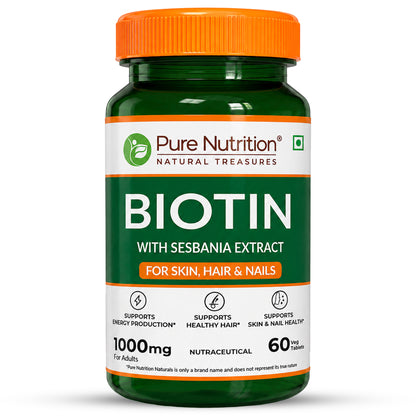
Biotin Tablet with Sesbania Extract
Listed offer: 5% off prepaid orders. Check the current product page for price, stock and offer eligibility.
Check Availability →Prices, offers and stock can change. Biotin supplements are not a guaranteed treatment for hair loss. Follow the product label and seek professional advice when appropriate.
The product name and total blend weight are not always the same as the actual biotin amount. Always look for the specific biotin quantity listed in mcg.
How many biotin tablets should you take per day?
The answer depends on the product label and your individual situation.
Do not assume that one 10,000 mcg tablet is equivalent to one nutritional serving. It is a high-dose supplement, not the adult nutritional requirement.
If a doctor has recommended biotin for a confirmed deficiency, follow that individual instruction. If you are choosing a supplement for general hair concerns, first check whether another condition could be causing the hair loss.
For help comparing supplement options, you can use the Pure Nutrition supplement quiz. It should support product selection, not replace medical advice.
When should you see a doctor about hair loss?
Speak with a qualified healthcare professional if your hair loss is:
- Sudden or rapidly worsening.
- Patchy.
- Associated with scalp pain, redness, scaling or itching.
- Accompanied by fatigue, weight changes or menstrual changes.
- Starting after a major illness or significant weight loss.
- Continuing despite changes in diet and routine.
- Associated with eyebrow or body-hair loss.
Women with heavy menstrual bleeding, people following restrictive diets and anyone with a history of low iron may need a broader evaluation. People with a family history of pattern hair loss may also need treatment beyond nutritional supplements.
You can learn more about possible nutrition-related factors in this guide to biotin and iron for hair loss in India.
If you are unsure where to begin, visit the Pure Nutrition free consultation page. A supplement consultation is not a substitute for diagnosis, testing or treatment by a qualified doctor.
How does protein intake relate to hair health?
Biotin is only one part of overall nutrition. Hair is made primarily of protein, so consistently low protein intake can make it harder to meet the body’s needs.
Indian diets can provide protein through:
- Dal.
- Chana and rajma.
- Soy and tofu.
- Paneer and curd.
- Eggs.
- Fish and chicken.
- Milk.
- Nuts and seeds.
Your protein requirement depends on age, body weight, activity level, health status and dietary pattern. You can use the Daily Protein Calculator for a general estimate, but individual medical or sports-nutrition needs may differ.
Do not start iron, zinc, vitamin D or other supplements solely because hair fall is present. Testing and professional advice can help identify what you actually need.
Frequently asked questions
Q. Is 1,000 mcg of biotin too much?
A. For most adults, 1,000 mcg is much higher than the 30 mcg nutritional AI. It may not cause harm in every person, but it is not a proven hair-growth requirement. Tell your healthcare professional about high-dose use before laboratory testing.
Q. Should I take 5,000 mcg or 10,000 mcg biotin?
A. Neither amount should be treated as a routine requirement. There is no established evidence that 10,000 mcg produces better hair growth than 5,000 mcg. Choose only with appropriate professional guidance and consider the risk of laboratory-test interference.
Q. Can I take 5,000 mcg biotin every day?
A. Some people take high-dose biotin daily, but “can” does not mean “needs to”. A healthcare professional should help you decide whether the dose is appropriate, especially if you take medication or have blood tests planned.
Q. Will 10,000 mcg of biotin make hair grow faster?
A. There is no reliable evidence that 10,000 mcg makes healthy adults’ hair grow faster. If hair loss is caused by iron deficiency, thyroid disease, stress, hormonal changes or pattern hair loss, high-dose biotin may not address the underlying cause.
Q. Can biotin cause hair loss?
A. Biotin is not generally known as a common cause of hair loss. However, new or worsening hair loss should not be blamed on biotin automatically. Review the full supplement, medication and health history with a professional.
Q. How long does biotin take to work?
A. There is no reliable universal timeline because biotin may not improve hair growth when deficiency is absent. Hair grows slowly, and the cause of shedding matters more than a fixed supplement timeline.
Q. Is two eggs a day enough biotin?
A. Two eggs can provide useful biotin, but they may not meet the entire adult daily AI on their own. Other foods in your daily diet also contribute.
Q. Is biotin the same as vitamin B12?
A. No. Biotin is vitamin B7, while vitamin B12 is cobalamin. They are different nutrients with different functions.
Q. Should I take biotin in the morning or at night?
A. There is no universal best time for everyone. Follow the product label and choose a time you can follow consistently. If the supplement upsets your stomach, taking it with food may be more comfortable.
Q. How many times should I take biotin tablets in a day?
A. Follow the serving instructions on the product label. Do not increase the number of tablets because you want faster hair growth. If the label is unclear, ask the manufacturer or a qualified healthcare professional.
Q. Ek din me kitna biotin lena chahiye?
A. General adult nutrition ke liye NIH guidance ke according approximately 30 mcg biotin per day kaafi hota hai. 5,000 ya 10,000 mcg tablets nutritional requirement se kaafi zyada hoti hain aur blood-test results ko affect kar sakti hain.
Q. Biotin tablets kitni baar leni chahiye?
A. Biotin tablet din me kitni baar leni hai, yeh product ke label par depend karta hai. Serving size check karein, multiple biotin products ko combine na karein, aur high-dose biotin lene se pehle doctor ya pharmacist se baat karein.
Final summary
Biotin is an important B vitamin, but more is not automatically better.
For general adult nutrition, the NIH lists an Adequate Intake of 30 mcg per day. High-dose products containing 1,000, 5,000 or 10,000 mcg are much higher than this amount and have not been proven to improve hair growth in every healthy adult.
If you are experiencing hair fall, look beyond biotin. Diet, iron status, protein intake, thyroid health, stress, hormones, medicines and genetics may all play a role.
Before a blood test, tell your doctor and the laboratory that you take biotin. If you are pregnant, breastfeeding, taking medication or dealing with sudden hair loss, seek professional advice before starting a supplement.
Sources
- NIH Office of Dietary Supplements: Biotin
- NIH Health Professional Fact Sheet: Biotin
- Mayo Clinic: Biotin oral route
- FDA: Testing for biotin interference
- Health Canada: Biotin and false laboratory results
- PubMed: Review of biotin for hair loss
Written by: Riddhi Shah
Clinical Nutritionist & Dietetics Expert
Master's in Clinical Nutrition and Dietetics · Certified Diabetic Educator · Advanced Diploma in Weight Management
Medically reviewed by: Anjali
Clinical Pharmacist & Healthcare Content Reviewer
Disclaimer: This article is for educational purposes only and is not medical advice. Consult a qualified healthcare professional before starting any supplement, especially if you are pregnant, breastfeeding, taking medication or preparing for laboratory testing.
Take the Next Step Towards Better Nutrition
Hair health involves more than one vitamin. Explore practical nutrition resources, understand your supplement options, and find the right next step for your needs.
-
Explore Biotin Supplements
Review the ingredients, serving instructions and current availability of Pure Nutrition's biotin supplement.
Check Availability -
Biotin & Iron for Hair Loss
Learn why nutritional deficiencies are only one possible cause of hair loss and why the right evaluation matters.
Read the Guide -
Get Personalised Guidance
Explore Pure Nutrition's consultation option if you need help choosing a supplement or understanding your options.
Explore Consultation -
Check Your Protein Needs
Estimate your daily protein needs and discover how balanced nutrition supports overall health.
Calculate Protein

