Health Supplements
Health supplements are concentrated sources of vitamins, minerals, amino acids or plant extracts taken alongside food to fill dietary gaps. In India they are regulated as food by FSSAI not as medicine so they support everyday nutrition rather than treat illness. Choose one by need, dose per serving and the format you will actually take daily.
Pure Nutrition health supplements cover everyday nutrition across vitamins and minerals, herbal and Ayurvedic formulations, omega fatty acids, probiotics, protein and targeted formulas for eyes, bones, gut, sleep and children's growth. Products differ in more than ingredients: some are single-nutrient tablets built around one specific gap, others are broad 30-plus nutrient multivitamins, and several use higher-absorption formats such as liposomal liquids, effervescent tablets and oral strips. Before buying, be clear about the need you are solving, the actual dose per serving, and whether a tablet, capsule, powder, gummy or strip fits the way you live.
What Are Health Supplements?
Health supplements are foods, not medicines. Under FSSAI's Health Supplements and Nutraceuticals Regulations, a health supplement supplements the normal diet with concentrated nutrients or substances that have a nutritional or physiological effect vitamins, minerals, amino acids, enzymes, probiotics and botanicals. The rules require the words "HEALTH SUPPLEMENT" on the front of pack, the advisory "NOT FOR MEDICINAL USE", a recommended usage level with the warning "Not to exceed the recommended daily usage", and nutrient quantities expressed as a percentage of the Recommended Dietary Allowance (RDA) set by the Indian Council of Medical Research. Labelling and advertising cannot claim a supplement prevents, treats or cures disease. Nutraceuticals sit in a related FSSAI category built around specific extracts and isolates, while classical Ayurvedic medicines are licensed by the Ministry of Ayush instead.
What's Inside This Health Supplements Collection
This collection holds everyday-wellness formulations that don't sit inside a single organ-specific category.
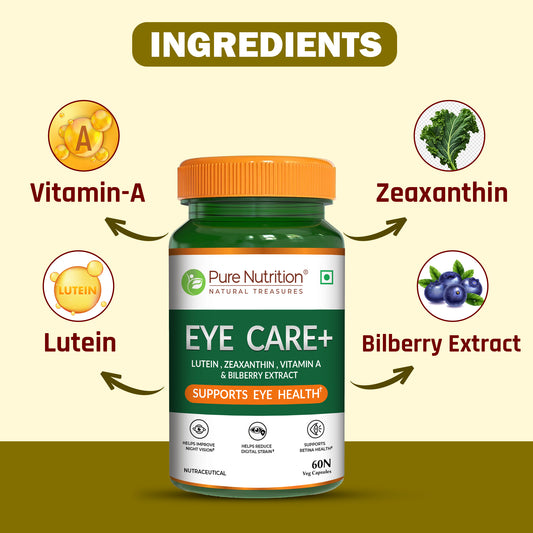
- Eye Care+ with Lutein, Zeaxanthin, Vitamin A & Bilberry — one vegetarian capsule daily after a meal, supplying lutein 12 mg, zeaxanthin 2 mg, vitamin A 672 mcg and bilberry extract 100 mg. A carotenoid-led formula for people with long screen hours, taken with food because carotenoids and vitamin A are fat-soluble.
- Multivitamin Kids Gummies – 30 Vegetarian Gummies — one gummy a day, preferably between meals, for children above three years. Combines vitamins A, C and E, B5, B9 and B12, zinc, lysine and ashwagandha in a chewable, gelatin-free format for children who refuse tablets.
The wider range extends the same category into specific needs: vitamins and minerals, immunity support, gut health and probiotics, bone and joint health, heart and brain health, hair, skin and nails, sleep and stress and protein and nutrition powders plus need-first entry points for men, women and kids, and a vitamin deficiency collection for shoppers working from a blood report.
Health Supplement Formats Explained: Tablets, Capsules, Powders, Gummies and Strips
Format decides whether you actually take the supplement, so it deserves as much attention as the ingredient list. Each format suits a different kind of nutrient and a different kind of routine:
- Tablets carry the highest dose per unit, which is why multivitamins, minerals and standardised herbal extracts usually come in this form. The trade-off is size larger tablets are harder to swallow.
- Vegetarian capsules are easier to swallow and need fewer binders, making them the common choice for probiotics, single nutrients and botanical extracts.
- Softgels and liquid-filled capsules are used for omega fatty acids and other fat-soluble nutrients. Take these with a meal that contains some fat.
- Powders allow flexible dosing and handle large servings well, which is why protein, greens and single herbs are sold this way. They only work if you are willing to mix them daily.
- Gummies suit children and adults who dislike tablets, but carry a lower nutrient load per serving check the added sugar on the label.
- Effervescent tablets turn a supplement into a drink, which helps build a daily habit. They often contain sodium, so read the nutrition panel.
- Oral strips dissolve on the tongue with no water needed, which makes them practical for high-dose or weekly vitamins.
- Resins and herbal juices are traditional Ayurvedic preparations measured by spoon or scoop. Expect a strong taste.
Examples across these formats include Multivitamin Tablets for Women, Probiotic 50 Billion CFU capsules, algae-sourced Vegan Omega-3, Organic Ashwagandha Powder and Vitamin D3 60000 IU Oral Strips. For nutrients that absorb poorly in standard forms, the high-absorption supplements range uses liposomal and bioavailability-enhanced delivery.
How to Choose the Right Health Supplement
Start with one defined need rather than a shelf of products.
- Name the gap. A blood report or clear symptom pattern beats general "wellness" buying. With test results in hand, start from the vitamin deficiency range.
- Check dose per serving, not label size. A 1400 mg tablet tells you nothing; the amount of each nutrient and its % RDA does.
- Read the nutrient form. Magnesium glycinate, methylcobalamin B12, D3 with K2 and chelated minerals behave differently from their cheapest counterparts.
- Match format to routine. A powder you never mix delivers nothing. Pick what you will use daily for 8–12 weeks.
- Avoid stacking duplicates. On a 30-plus nutrient multivitamin, adding standalone zinc, B-complex or vitamin A can push you past the recommended daily usage.
- Check suitability. Confirm vegetarian or vegan status, added sugar, allergens and the minimum age on children's products.
How to Read a Health Supplement Label in India
A compliant Indian label tells you most of what you need. Look for the category declaration "HEALTH SUPPLEMENT" or "NUTRACEUTICAL" on the front of pack; the nutrient table with quantities and % RDA per serving; the recommended usage level; the advisories "NOT FOR MEDICINAL USE" and "Not to exceed the recommended daily usage"; and the FSSAI licence number. A product promising to cure or reverse a named disease is making a claim this category is not permitted to make.
Who Should Consider Health Supplements
Supplements are most useful where a real gap exists: a confirmed deficiency, vegetarian and vegan diets (commonly B12, omega-3 EPA/DHA, iron and zinc), older adults, people training hard, and children with limited dietary variety. They are least useful as a replacement for meals ICMR-NIN's Dietary Guidelines for Indians emphasise meeting nutrient needs through a varied diet first. If you are pregnant, managing a chronic condition or on prescription medication, speak to a doctor before starting.
Pure Nutrition Health Supplements at a Glance
Pure Nutrition is a D2C nutraceutical brand manufactured by Herbs Nutriproducts Pvt Ltd, Mumbai. The brand states its products are made at GMP-certified facilities and that every ingredient is tested for identity, purity and potency by an in-house quality control team and laboratory. The range is built around vegetarian formats and pairs standard vitamins and minerals with Ayurvedic botanicals such as ashwagandha, shilajit, amla and moringa.
Frequently Asked Questions
Q . Are health supplements safe to take every day?
A . Most FSSAI-compliant health supplements are safe for daily use at the recommended serving. Risk comes from exceeding the stated dose, doubling up on the same nutrient across products, or high long-term intakes of fat-soluble vitamins A, D, E and K, which accumulate in the body. Our guide on whether multivitamins are safe in India goes deeper.
Q . Do health supplements need a prescription in India?
A . No. Health supplements are regulated as food by FSSAI and sold over the counter. Medical advice is still worth taking if you are on treatment, since vitamin K, iron, calcium and botanicals such as ashwagandha can interact with prescription medicines.
Q . How long do health supplements take to show results?
A . It depends on the nutrient and the size of the gap. Water-soluble nutrients such as B vitamins and vitamin C reach steady levels within days to a few weeks. Correcting a vitamin D or iron deficiency, or seeing change in hair, skin, joints or sleep quality, commonly takes 8–12 weeks of consistent use.
Q . What is the difference between a multivitamin and a single-nutrient supplement?
A . multivitamin covers many nutrients at moderate doses; a single-nutrient supplement covers one nutrient at a higher dose. Multivitamins suit general dietary cover, while single nutrients vitamin D3, B12, magnesium, zinc, iron suit a specific, ideally test-confirmed gap. Taking both without adding up totals is how people overshoot the recommended daily usage.
Q . Should health supplements be taken before or after food?
A . Take fat-soluble and oil-based supplements with or after a meal, and others as directed on the label. Carotenoids, vitamins A, D, E and K and omega-3 softgels absorb better with dietary fat. Probiotics, iron and some herbal extracts carry their own timing on-pack, which takes priority over general rules.
Q . Which health supplements are suitable for vegetarians and vegans?
A . Look for veg tablets and capsules, plant-based omega sources and gelatin-free gummies. The Pure Nutrition range includes algae-sourced omega-3, lichen-derived vitamin D3, vegetarian capsules and gelatin-free gummies. Vegetarians and vegans should pay particular attention to B12, omega-3 EPA/DHA, iron, zinc and vitamin D.
Q . Can children take health supplements?
A . Only products formulated and labelled for their age group. The Multivitamin Kids Gummies, for example, are labelled for children above three years, one gummy a day. Adult multivitamins should not be halved for children, since nutrient ratios and dose ceilings differ. See the kids wellness range for age-appropriate options.
Disclaimer: Health supplements are foods, not medicines, and are not intended to diagnose, treat, cure or prevent any disease. They are not a substitute for a balanced diet or for medical advice. Always read the product label, follow the recommended daily usage, and consult a qualified healthcare professional before starting any supplement particularly if you are pregnant or breastfeeding, under 18, managing a medical condition or taking prescription medication.